Creating a volume
Data / Volumes → New volume opens one dialog.
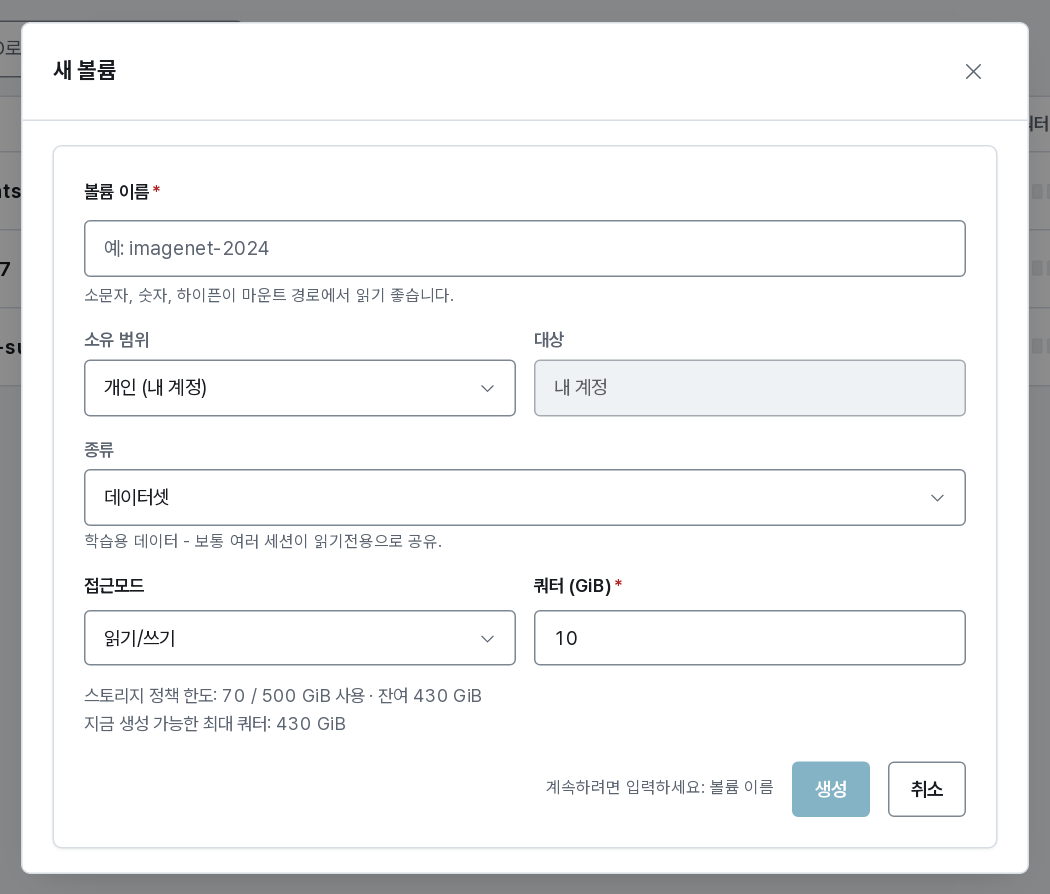
The fields
Name
Lowercase letters, digits, and hyphens read best, because the name is what you will type into a
mount path later. imagenet-2024 beats ImageNet (final!).
Owner scope
- Personal (my account) — yours. Nobody else sees it until you share it.
- Group share — offered to group administrators. Every member of the chosen group can mount it as soon as it is created; no sharing step is needed.
- Everyone — offered to platform administrators. Every signed-in user can mount it. Keep it read-only unless anyone really may change the files.
Target follows the scope: your account, the group you pick, or everyone.
Type
Dataset, personal workspace, group share, or scratch — see the table in the overview. The dialog shows a one-line description of the type you selected.
Access mode
| Mode | Meaning |
|---|---|
| read/write (RWX) | Sessions can write. Several sessions may mount it at once. |
| read-only (ROX) | Nobody can write, not even you, from any session. |
This is the volume's ceiling. A session can always mount a read/write volume read-only
(the wizard offers the choice), but never the other way round. A dataset you want to protect
from an accidental rm -rf is best created read-only.
Quota (GiB)
How much the volume may hold. Two ceilings apply, and the dialog shows both:
- Your policy's storage limit — 70 / 500 GiB used · 430 GiB left in the screenshot. It is the total across all your volumes.
- What the storage server physically has free.
The larger request of the two is refused before you submit, with the number that would fit.
After creating
The volume appears in the list at once with 0 GiB used. The storage itself is provisioned lazily: the first session that mounts it creates the underlying claim. That is normal — a volume that has never been mounted holds nothing and costs nothing.
Nothing is charged at any point: volumes are free, bounded by quota rather than by credits.
Growing it later
A quota can always be raised later (Resizing) and never lowered below what is stored, so starting modestly costs you nothing.